|
VINNITSA OBLAST
|
|
|
At
ten o'clock
in the morning, Vlad came to pick us up at the Hotel Dnipro,
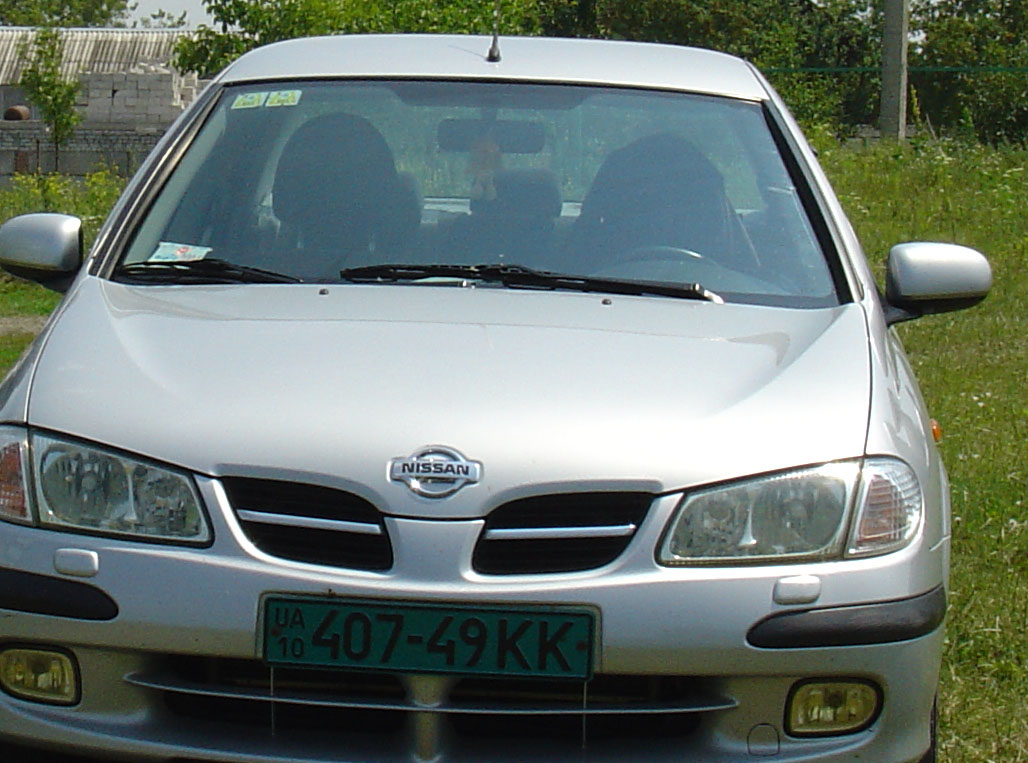
with a Nissan belonging to his brother Timur of a
style we had never seen in the US. On its front bumper it, read "Nissan Century."
"What a conspicuous looking car....", giggled Heidi by gobbling up the remaining words. We filled the car with gas at a rate of $2.00 a gallon, coincidentally, the same price as in California. The second thing to do was to exchange some dollars into Grivnias so we could buy lunchmeats and other foods at the delicatessen. Once the shopping was completed, it was time to depart. We went west on highway E-40. I must introduce how Vlad then did something rather unusual. It was after we exchanged Grivnias from Dollars at the bank. Vlad hid himself behind the car while he divided the dollars bills into three and inserted one inside of his left sock and the other in his right sock. He placed the third set, three ten Grivnias notes, in the open on the car dashboard. Watching Vlad’s actions, I wondered what he was doing, and then asked, "What are you doing, Vlad?" Looking back at me, Vlad gave a big grin to me. I guessed momentarily and felt alarmed. I needed no further explanation from my dear student for I remembered the warnings about the highwaymen written in a few Ukraine guidebooks. In one it read, "keep all cash divided separately in different areas." I, too, followed Vlad and imitated what he did immediately. They say it is still not yet safe enough for foreigners to travel through the remote areas in Ukraine, especially for an Asian, because Asians are rarely seen there, suspicion surrounds them. I was especially concerned with the comment about Asians being victimized. I, in fact, contacted some agencies and received second opinions that indicated that this was not so. Therefore I ignored some of the advice given to me – particularly the suggestion that I should disguise my self with a large hat and shaded sunglasses. What I did not know of Vlad was his intention about the bills he placed at the dashboard. Responding upon my inquiry, Vlad explained to me it was for the "DAI." DAI (aka "Auto-Inspection Officers”) is a State authority that patrols along the state highway in a group monitoring motorists with speed guns in their hands. It was said that they stop the motorists for no apparent reasons and penalize the driver with a fine for even the most minor of infractions or will create an infraction. The local residents once were victims of the authority’s threats. Vlad told me that he was willing to pay the “fine” if he was penalized with the cash he placed on the dashboard. To me it was quite a convincing story since the grivna notes were ready to be paid. The State Police or the DAI receive very limited salaries and they compensate their income from the motorists’ payment of the “fines”. Vlad was behind the wheel, I was sitting next to him and Heidi stretched her legs behind the seats as we started the car. Our initial plan for the journey today was, first, to drive to Zhitomir using the state highway E-40 going southwest. At Zhitomir, once the largest Jewish shtetel in Ukraine, we would turn our car 90 degrees south onto E-583 bound to Berdechev. The final stretch would be from Berdechev to Vinnitsa, the capital of Vinnitsa Oblast. At Vinnitsa, we should locate an appropriate hotel for our weeklong stay. I understand it is 92 miles to Zhitomir from Kiev. From Zhitomir to Vinnitsa is 80 miles for a total stretch of 172 miles. If we obey the 60 KM(37.5 mile) per hour speed limit, we should be able to arrive at Vinnitsa within four and a half to five hours. The speed limit noted here, however, is for residential driving while there are no specific limits posted on the state highway. There are two kinds of town signs along the side of the road; one with name of the village or town and others with the name and slash ("/ ") marked through the name. The sign without the slash indicates one is entering the town and sign with the slash indicates one is exiting the town. While driving on the highway, we had to follow the 60 KM speed limit on the road as we arrived in a new town, maintaining that speed until we passed the town. We had no reason to call attention to ourselves nor to satisfy any passing curiosity of the DAI; our intention was to take our time driving without provoking the inspectors. Our concerns regarded the accommodations. I heard there were apartments, other than hotels, which could be leases for a week long stay. Heidi and I were determined not to pay any attention upon the local offers for we had had enough surprises at the Soviet apartment in Kiev. Our intentions were to search for the highest rated hotels. Though we may be charged more expensive rates, the strength of the dollar would make our stay affordable in order to ensure we had the safety and sanitation we needed. Since Vinnitsa is the capital of the Oblast, we assumed the city must have hotels equipped for international guests. Vinnitsa was chosen as our base for our genealogical research because it was only a daily commute to the places we need to reach; Litin, Bagrinovtsy and Sharogrod. I spent three entire years preparing for this trip. In my mind, therefore, existed an accurate road map, though it lacked any sense of reality. Towns I selected to visit to take pictures, videos and to speak with current residents were Zhitomir, Berdechev and Kalinovka. Zhitomir was once called "Jerusalem in Ukraine", the oldest of shtetels. Berdechev was another historical shtetel that suffered a huge execution during the holocaust one week ahead of Babi Yar. Kalinovka was the hometown of Rose Feldman’s father (Rose Feldman publishes the web site LITIN). I had promised Rose that we would take some of photos of Kalinovka.
As we drove on the state high way, we all were stunned with the well-maintained road and the modern gas stations we saw every two to three kilometers or multiple brands standing side by side. I remembered an incident when Vlad laughed at me as I told him about how Ukraine, a newly formed republic, and its industrialization would have an impact on the urban establishment. I told him some years back that to equip the state road with modern technology and to build gas stations of multiple brands would establish the republic for the motor vehicles – only this would close the distance between the urban cities. "Mr. Yamaguchi, you don't understand their mentality for their mind set has remained the same for one hundred years." He was referring to Ukrainians. "They have no concept of a motorist’s life and how transportation could build the industries."
I now stared at Vlad, who also appeared to be surprised to see such a modern looking high way. "I don't believe this!" Vlad murmured. There were two wide lanes going both directions – such an expansive and wide-open high way. As we drove through the local villages and towns, we saw behind the town houses, huge endless green fields reaching far into the distance, all the way to the horizon. I indeed enjoyed the typically described appearance of the western Ukraine. But let me write about a few views that struck me as being quite unusual. Those
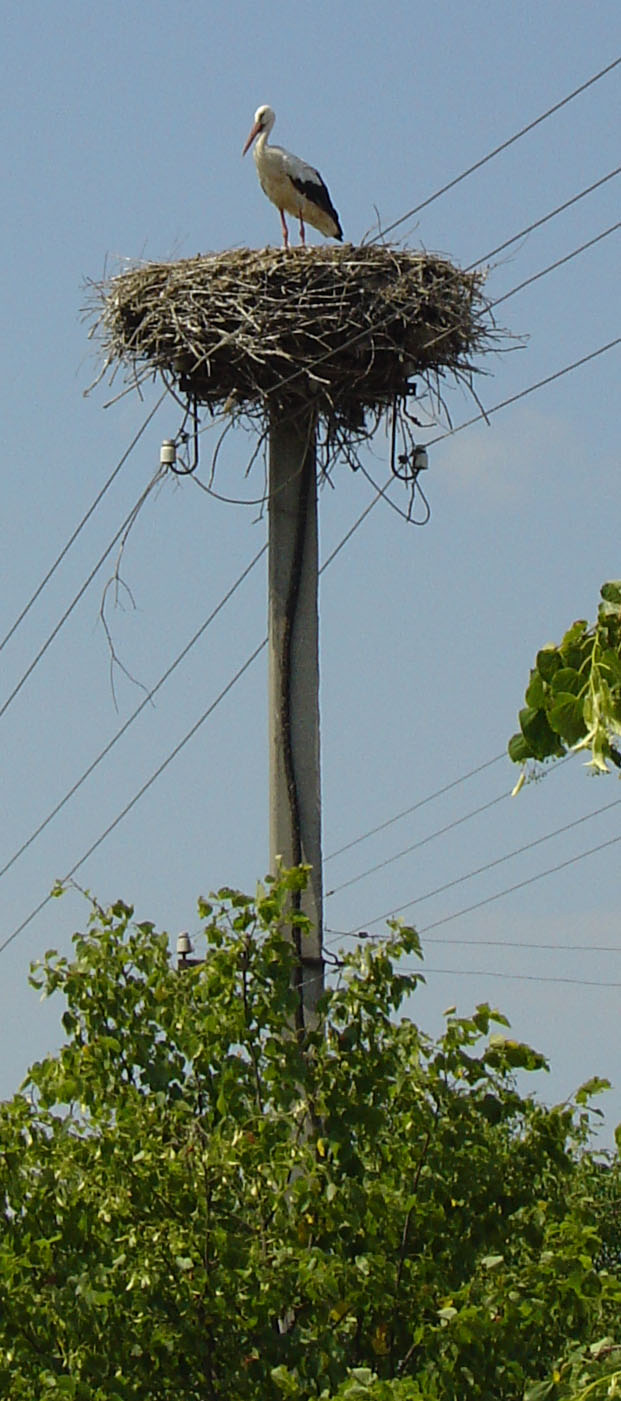
telephone poles made of tall wooden spikes did not seem odd to me. But
the birds’ nests at the top of poles most certainly did.
The
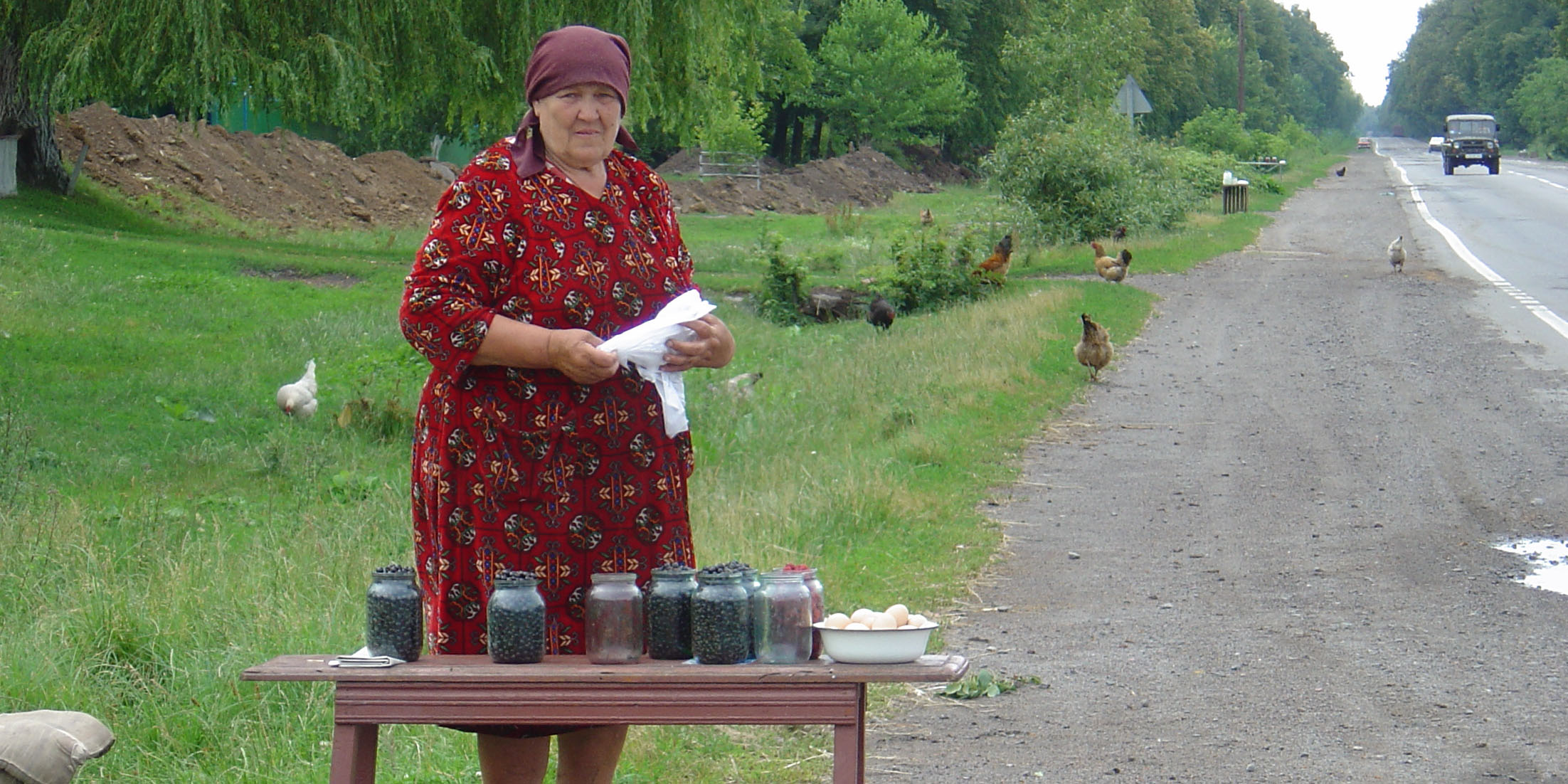
vendors along the side of the state highway also gave us peaceful
and happy thoughts. They appeared to have erected their stand with only
the use of small wooden tables or stools on which jars of fruits were
displayed.
I wondered if one has to register for permits or not.
I knew it was only a thought that was not my business. One more sight hit me with peculiar fascination. As we drove, we could see endless green fields. Near Kiev, we enjoyed the green panorama. But the panorama soon disappeared as the tall forests along the side of the road shielded the open fields from our view. We could see the fields again as we came upon the villages and towns. The forest was so thick and dark that we could not see anything beyond the forest. I wandered why? The forests could have been planted during the wartime for some military tactical reasons. Perhaps this was a means to keep observers away from knowing what lie beyond the forests. We
needed to drop by a market along side of the road for a few things we
had forgotten to buy in Kiev. It appeared we caught a strong local
curiosity among the native peoples who at the market stared at us as if
we monkeys in zoo cages.
A young Ukrainian lady who served us confessed that she had never
heard any languages other than Russian or Ukrainian before.
She wanted know what language we were speaking. We were loudly
chattering in English. “Anglicanskee
?!” Her reaction when she learned what language we were using gave her an appearance of a little child who listens with intense curiosity. She confessed then it was her first time hearing “English.” That comment made us convinced we were a long way from home. We
were driving southwest staying within the recommended speed. It had been
over two hours since we left Kiev, and it was now approaching noon. The
view outside began to change.
The deep green seas of fields gave way to waves of heavy forest.
I remembered reading the descriptions of the landscapes of
Zhitomir Oblast, called “Poricia” in medieval times. We were now
near the city “Zhitomir” Vlad’s
cell phone began to ring.
It was Timur, his brother.
It was most considerate of him to keep track of our travels so
perfectly, despite being very busy.
Timur was giving Vlad advice as to when to turn off the state
highway to go south in order to reach Zhitomir. My initial plan was to
drive through Zhitomir before turning onto State highway E583.
Timur, suggested going south instead, in order to avoid the city
traffic. I had no problems not going in the city because I had planned
to stay over night in Zhitomir on our return to Kiev. Within
30 minutes, I could sense that we were now stepping into the land of
Podolia. The fields of
black soil spread all the way to the horizon. I never had seen such a
breath taking view. Before me was a field with bright sun shine-like,
fully blossomed yellow sunflowers sprawling for what appeared to be
miles into the distance. My heart started to thump.
This black soil was considered the richest soil in the world with
a depth of one meter. Vlad
once jokingly told me that if you placed a broken branch into the black
soil, it would begin to root within a couple of weeks. It
could not be possible, but who knows, for I knew of a fairy tale in
Japan where it was said that an old man who could make a dead tree
blossom. I also heard a story that bagfuls of the Ukrainian rich soil is
exported to neighboring countries for use by nurseries.
That I could believe. Podolia had been known to be a farming haven since ancient times. Unfortunately, this was the very reason the land was targeted for invasion and occupation by neighboring kingdoms. A City Sign of Berdechev appeared. This was the town of Vassily Grossman. The town was known to be the biggest Jewish town during the 18th century, even larger than Zhitomir. It was in the 14th Century when the city was once administrated under the Kingdom of Poland and Lithuania before it merged with the Old Russian Empire in 1793. The city once was called “Jerusalem of Bohemia”, the land of Hassidic Jews. The Nazis destroyed the city and 18,640 Jews were executed at the old military airfield two weeks prior to Babi Yar. My plan was to spend an entire day in Berdechev on our way back, therefore,
as for this day, we decided to take a couple of hours rest while we
visited at the Old Jewish Cemetery and took some photographs. It did not
take us too long to locate the cemetery.
It was awesome to find many tombstones, some dating as far back
as 1700 AD. The thousands
of stones were mildewed, weather-beaten, falling over and some were
crushed under the big tree roots.
Photo1)and Photo2). The time is three o’clock in the afternoon. Fortunately I no longer was experiencing fever, and yet it was time to get going. The rest of the tasks we should complete when we come back to Berdechev next week. We all climbed back into our Nissan. Next stop would be Kalinovka, Podolia, considered as a suburb of Vinnitsa.
Unexpectedly, we had a difficult time locating the sign of Kalinovka.
There was none. Instead, we found a
bus stop with the name “Kalinovka” printed on its rooftop.
The bus stop was decorated with mosaics as were all the bus sheltered we
saw from this time on in every town we visited in Podolia. There were no
signs or evidence that there ever existed any synagogues. However, we
found a Russian Orthodox Church, where we had a small picnic lunch in
its grounds and stretched and rinsed our legs out by the well with
ice-cold water. It was ever so refreshing. It takes only 20 miles from Kalinovka to Vinnitsa. I was satisfied the way everthing worked out for the day. It was now 4:40 PM, the timing was perfect to get in the city to find the hotel, settled in and prepare for the trip to Litin tomorrow. It
takes only 20 miles from Kalinovka to Vinnitsa.
I was satisfied the way everthing worked out for the day. It was
now 4:40 PM, the timing was perfect to get in the city to find the
hotel, settled in and prepare for the trip to Litin tomorrow. Vlad’s
cell phone rang again.
It was not Timur, this time. It was the father of Natasha’s
friend.
Vlad had forgotten to tell me that a close friend of Natasha once
lived in Vinnitsa. This gentleman was willing to help us locate a hotel
during our stay in Vinnitsa. His
name was Sergei, a well-known businessman in Vinnitsa who often visited
Timur’s family in Kiev.
Heidi and I felt this person would be perfect to assist us - the
locals always know the best places. I over heard Vlad making
arrangements for a rendezvous to meet this man at the entrance of
Vinnitsa city. I found Sergei to be a well-dressed gentleman when we
met at the designated rendezvous point. We followed his car into the
city. Vinnitsa was bigger than I had expected, although its size was
logical since it represented the entire oblast, Vinnitsa.
We got out of the car when Sergei directed us to do so and
proceeded to follow him through the streets in what appeared to be the
central part of the city. We entered one of the hotels, which was in the
middle of a renovation. The lobby had a marble floor, giving us the impression that
this was once a highly rated hotel.
The hotel managers treated us as though we were quite important
guests. I perceived the
treatment was the effect of the authority held by Sergei. Heidi often traveled to the Western Europe. She, therefore, was accustomed to selecting suitable accommodation for herself. And yet, we were now in the Eastern Europe. The architecture of the hotel looked impressive as far as its appearance was concerned, though its damaged interiors told us that the cleanliness of the building sanitation could not guaranteed. We understood that the town survived many heavy air bombings and battles in the street and the town still was in the process of rehabilitation. The city of Vinnitsa,
incidentally, once was the war headquarters of Nazi Germany during WWII.
In 1942, Hitler lived in a bunker code-named “Ware Wolf.” It
was said that the city was completely destroyed by the air bombardments. One block away from the hotel
office, we found an adequate room at the Hotel Ukraine.
It was room 315 on the third floor. For Vlad, we also took a
second room on the second floor. Vlad
was a native Ukrainian who never complained about where he spent his
nights sleeping. In fact, I
saw that he was quite comfortable sleeping in a sleeping bag in the
center of Timur’s kitchen on the first day I arrived in Kiev. I knew
then, that he was the perfect guide for us.
Although he insisted on sleeping on the couch in the lobby of the
hotel, we found a decent room for him to sleep. I calculated the total room costs to be around 880 grivna or US$170 per night including Vlad’s room and breakfast for all of us. To avoid any misunderstanding, I
need to explain the economy in Ukraine. Though the official exchange
rate of US Dollars in Grivna was 1:5.3, the average Ukrainian earned
only 800 grivna per month. While
the cost of accommodations for American was considered relatively
inexpensive, the cost of the rooms was equal to one-month salary for a
Ukrainian. From the point of view of the locals, we were spending an
amount they would dare not to waste on hotels in Vinnitsa. We learned at this time that some
drivers substituted methane for gasoline.
And once we saw a cabdriver turn off his car engine while waiting
at a stop light in Kiev. Anyway, since we have settled into our accommodations for the week, we were greatly relieved and decided to invite Sergei to the Podolia Restaurant for dinner. It was the same as in Kiev; the food in Ukraine must always be excellent. We enjoyed flavors we had not tasted in California. Tomorrow would be the day I would
visit the town I had dreamed about for three years.
Would it really exist? And what would it look like? I trembled in anticipation.
|