|
|
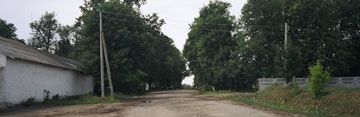
LITIN
|
|
|
|
In
the morning, I was awakened by lightning and thunder; a big storm.
The time is 6:00 AM. Our
breakfast was scheduled at 8:00 AM. It should be delivered at our room
from the kitchen. I sensed trouble creeping up to me. There was a pain
in my throat.
My colds
always start in this way. This was what I did not want to have happened
on this trip. If this is a cold, I hoped it not be accompanied by a
fever. I
am now only twenty miles away from Heidi’s family home.
I could not imagine crashing right here and therefore too sick to
see what I had come so far to see. Getting
up from bed, I took three tablets of Tylenol.
The bottle was almost empty.
In preparing for this trip I packed various types of medicine for
stomach and a big bottle of Tylenol, which I came to realize, was nearly
empty. I am allergic to
Aspirin. My concern was
whether any non-Aspirin was available in Ukraine, particularly in such a
remote area. I had been told adequate medical technology was sorely
lacking and one guide even suggested that should there be an emergency,
one should go to a neighboring country for hospitalization. It
is certainly not a good idea to get wet in the rain.
The only thing I could do was to cancel this day’s original
plan; and the plan was to go into Litin. Fortunately
or unfortunately, the sky became clear with blue by the time the
breakfast was delivered to our room. At 9 O’clock in the morning, we departed for Litin. |
|
|
APTEKA and DAI "Apteka" is a pharmacy shop. On this day, I learned that every town we visited in Ukraine had at least one or more APTEKA. We left the hotel to find the pharmacy. At the far end of Vinnitsa, we finally found one. When I entered the store, the pharmacist stood behind a glass counter filled with many medicines. As I began to tell her my ailments, I found she was a well-trained physician. She, of course, did not know the brand name Tylenol, and yet by explaining that I was looking for NON-ASPIRIN tablets, she understood what I needed. We were very impressed with the facility and the quality of the APTEKA – this gave us relief in that it was likely we would need a pharmacy again as we continued traveling the country. As far as the pharmacy, Ukraine was as good as any other Western European nation. Now we were able to concentrate
on our trip today since everything seemed to be going well, but we
immediately encountered some trouble. We encountered a bit of intensity
when the DAI stopped us as we were leaving the city limits. It was, however, less troublesome
that we imagined – the DAI only checked Vlad’s passport and once
checked we passed through the checkpoint safely.
As we were residents of US who were not accustomed being
investigated by machinegun-carrying enforcement personnel, I could not
help but think about what may await us in the future. It was a day that had had an
unexpected beginning which caused me to remain cautious about what could
happen next.
"No,
not at this time!" According to the map, the
distance between Vinnitsa and Litin is 32Kilometers. There was a time
when I would run the San Francisco Marathon every year and did so for 20
year. Accordingly, I can sense exactly the distance represented by 32
Kilometers. A marathon is
41.91Kilometers. It may
sound a little cavalier but the distance is not that far away. In other
words, I could run the distance between Vinnitsa and Litin and using my
personal best, it would take me 2hours. Those names listed in the map
that I had memorized all existed, why wouldn’t they exist - it would
not make sense otherwise. But, it was still so exciting to me to find
the towns on the map showing up exactly in their proper order as we
drive down the road. I had
only learned the names using the map and not by actually seeing the
towns. I was simply amazed with the fact that the map depicted the
truth. My mind worked as if I were so
afraid to miss anything; it was absolutely essential that my eyes
register everything with out fail. Eyes of mind hungered for all that
appeared in view. Any sight
I would not remember disturbed me for that would be my failing forever. I kept my camcorder camera
running. The fields on both sides of the state highway appeared to be
filled with sugar beets, the major crop of Podolia; a key ingredient in
a familiar dish we usually associate with our Thanksgiving banquet.
Beet salad, in fact, is one of
Heidi’s favorite dishes. All
of a sudden, I heard Heidi request that we stop the car so she could
touch the sugar beets – the vegetable, she said, of her family.
I panicked – we were just seconds away from Litin –
the place I had dreamed of seeing for so long. Even many weeks after this
episode, Heidi was still laughing at my reaction to her request -
obviously I acted so strangely then. ‘You didn’t sound like
yourself, Norimi’, Heidi kept saying. ‘You yelled at me saying,
“No!”’ In my family I am always the
subordinate one. I have
never told her “No.”, as far back as my memories serves me.
If I did, it would have been the first and last incident in our
life. I must confess,
however, I had no recollection of this incident of telling her “No”. “Did I really say that?” I responded whenever she brought
up the conversation. I would have found out she was
right upon our return to the US as I played the camcorder video on out
TV monitor. Our conversations were clearly recorded in the video and I
heard my own voice yelling frantically, “No, Heidi, not at this time
yet!” Shame on me.
I will not be allowed to forget this incident my entire life! LITIN DISCOVERED I saw a sing read “Sarovoe”, I sensed
it would be Litin coming up next. I was wrong at this time for there was
one little village that was not listed in my map. But it was just the
matter of time, and there, I saw the town sign read “Litin.” On the right hand side of the state highway, there were
two signs, one built by the city welcoming the motorists and another,
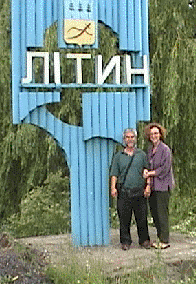
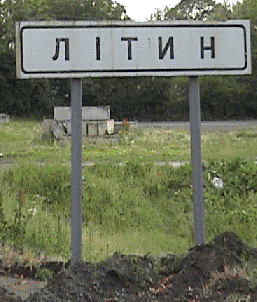
which was just a green sign, provided by the state. There lay Litin indeed. The town of my fantasy proved to be a real town in which Heidi’s great grandparents resided until they immigrated to the US with their children. Navigating with only one official record where “Litin” was listed in the ship manifest found at the Ellis Island records, three years later we are standing on that very land. Heidi appeared to be quite fascinated, too. I thought our first mission was
to understand the town and gain our bearings and sense of direction
including marking the locations of major buildings.
Since our plan was to commute into Litin each day this week, we
did not need to begin our detailed research today. It was difficult but
I disciplined myself not to start interviewing people and taking
pictures; I asked Vlad to just drive around the major streets until we
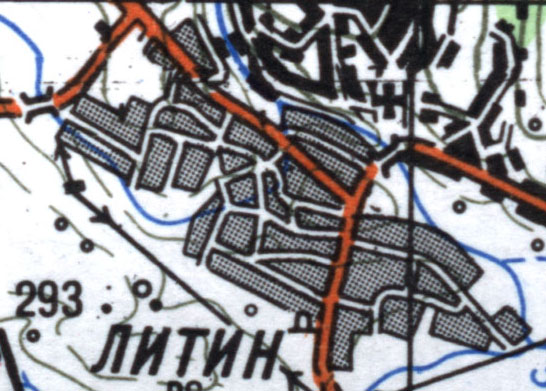
had a idea of where everything was. We drove along the state highway into the town. The street was named “Lenin” which appeared to be the main street. It made sense that such a major road ran through the center of town. We passed a large public park where some official looking tall and big concrete buildings stood, upon which flew the nation’s flag. In the park, there were some heroic statues and portraits displayed on a large billboard type sign. Those buildings appeared to be official buildings possibly a city hall and or a memorial hall. And still standing was a statue of a man familiar even to us, “Lenin” himself. Though we entered at the eastern
entrance, the road soon started to turn toward the right.
There were some narrow streets leading west and yet they all were
minor streets. I sensed the
road would lead us toward the northwest exit of Litin. We also passed a crowded market
where various merchants displayed their merchandise.
For ten minutes, we cruised for 8 kilometers then parked the car
at the end of the town. We
saw the endless state highway reaching in front of us.
This road should be bound to Lechetev.
On the corner of the small road, which ran northeast to
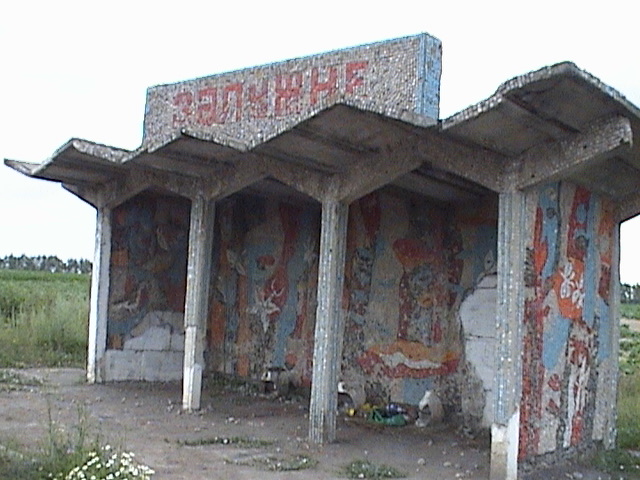
southwest, we got out of the car. In
front of me stood a peculiar looking bus stop decorated with tiles in a
mosaic pattern. I should have returned to the
eastern entrance once more to confirm the view we saw, however, I was
unable to control my curiosity any longer. I began taking photographs
and videos as well as engage in conversation with the local people.
What surprised me was that the peoples we tried to speak with
were not as friendly as others had been in previous towns. They appeared hesitant to respond to any of our questions. At least, however, we were able to locate the Jewish cemetery from our queries. But the locals were not enthusiastic talking with us for whatever reason; they were either too busy or were not familiar with foreigners. Vlad suggested regrouping to
amend our plan. I became rather pessimistic by our encounters with the
unfriendly Litiners. We all went back to the car and drove back to the
downtown areas. We passed the market and among the stores we found a
post office. I had an idea so I suggested to Vlad that he park the car
behind the post office. We walked inside the post office. As I guessed, there were some
souvenirs displayed inside. We
purchased some post cards, envelops, postage stamps and stationery and
proceeded to ask the storekeeper some questions.
I had understood that there was an old section and a newly
developed section. Where was the old section in the town? Was there an
old residential district for Jewish people? And was there an old big
church or cathedral? And etc, etc… we were asking those questions,
just customers who had just bought some merchandise. Surely we deserved
some attention? I was
right. Now, we were getting
somewhere. There was a reason why we asked the question about a
cathedral. I remembered a story told by one of the members of the Pervin
family that the Litin Pervin group lived near a large church, that is, a
church not a temple.
Consequently, I interpreted this to mean a Russian Orthodox
cathedral.
I thought the large cathedral might lead us to the location of
the Pervin house. As I expected, the question
brought a positive answer. We
were told a huge cathedral once existed but had been demolished and yet
now the town was in the process of rebuilding it on the old site. Great;
we needed to know where is it then? The answer was in the main park -
the one we had passed by earlier. We
went back to the car and drove to the park, but it was too big to find
the so-called construction sight. We were lost. Vlad and I saw three men who were
talking in the middle of an intersection.
We slowed down and stopped the car near them and spoke from the
window. Vlad asked if they
know the location of the construction site for the old cathedral.
I thought it was a simple question.
And yet we did not hear a simple answer. We were now subjected to their
inquiries. The conversation became intense. Our middle-aged interrogator
with sharp eye contact was asking why we wanted to know this. Now he was
asking us a simple question, “What for?” At this point, I sensed they were very suspicious of us for some reason. Speaking in English, I told Vlad to tell them directly that we came all the way from America to search for the old house of our family who had once lived near the cathedral. It was to our
advantage that we came from the United States. The suspicious look of
our inquisitor suddenly relaxed and he began to direct us to the
cathedral site by his outstretched hand. His face again showed his
distrust when I made a big mistake. I already stated in the previous
pages that we brought some cartons of “Camel” cigarettes to use as
souvenirs. In my stupidity, I offered a couple of “Camel” packets as
an offering of gratitude by simply handing them to the gentleman from
the car window. It was too
late by the time I noticed Vlad signaling me “Don’t.” I saw the man’s face
stiffened. He asked, “What are they?”
I explained they were American cigarettes. He pursued his
questioning, “Why should I accept the cigarettes?” It was then that
I realized that I had made a mistake. I had offended him with the
offering. By pulling my ‘gift’ back through the window while
apologizing to the man, we quickly drove away from the scene. While living in the US
for the past 40 years, I became quite accustomed to distributing
presents. I had forgotten that such an action might offend people under
certain circumstances. Vlad
lectured me afterwards explaining how the people in Podolia were very
proud people; it would be shameful if they were to take a gift without
any reason. It was not the last
time we would see this man. After
passing two or three blocks, we arrived at a spot, which was only a
5-minute walk from where we were. We were lost again and found no
pathway leading to the city square where the statue of Lenin stood.
After driving a few times on the same road, we saw the same man;
he held his arms above his shoulders gesturing for us to come his
direction. Driving towards him, we saw the construction site of the
cathedral – no wonder we could not find it – just the
foundation had been built at this stage.
What surprised us most was that the man to whom I had earlier
offered the cigarettes was actually the state inspector for the
cathedral’s reconstruction. His name was Sasha. I
was so embarrassed to see him again – I wanted to dig myself into
a hole and hide. (There
was, in fact, a big hole in front of me due to the lack of maintenance
of the road). One more big surprise – Sasha was now a different
person - he was kind, gentle and even friendly. As if we were his long
time friends, he introduced us to the engineers – a crew of around
5. He even summoned some if the neighbors who lived near asking them if
they knew of any early history of the town. A few of them stated that there once stood a
pair of large dwellings adjacent to each other only ten meters away from
the construction site. The episode about the
residents of Pervins was told as follows: Leib and Schandel had
fourteen children. The
brother of Leib, Israel and his wife had six children. Both families of
Leib and Israel lived in the adjacent houses with more than ten servants
between them. There was a big cathedral standing near by their home. I realized my voice
was quivering as I spoke. We were told that the houses were still
standing, albeit vacant, for quite a while until the 1960s when the city
hall was built next to them on the same site. They said that we might be
able to see photographs if we were to find the early ones of the
renovated city hall. They suggested we visit the city’s museum but it was Saturday, and as it was in the afternoon, the museum was closed. We stood in the open space where once was the Pervin resident and fantasized the day of one hundred years past within the wild weeds overtaking the space. It appeared to be a large tract of land. We were anxious for Monday to arrive to begin our search of the old photos. The
map on the left shows the birds eye view of Litin. Click on the names of
each building to view them more closely. A
Family Myth About Sugar Beets Factory There
is a tale told among the Pervin family for a number of generations.
One of those tales is about how a member of the Pervin family
obtained first-class Russian citizenship despite the fact that Jews were
considered second-class citizens. Most importantly, the family owned a large parcel of land,
thought to be quite unusual for Jews of this time. This was made
possible by the first generation of Leib Nicholiavitsi, who served with
the military for a life-long assignment.
It was Leib Nikoliavitshi who earned the rights to first-class
citizenship and accordingly was awarded all the rights of this
citizenship by the Tsar including the ownership of land.
However, none of his family had any documentation of the exact
location of the property. Israel Samuil, the younger brother to Leib
Yahuda remembered the name of the factory called “Loznansk Sackerine”
and yet no one could explain if this represented an individual or a
location. My
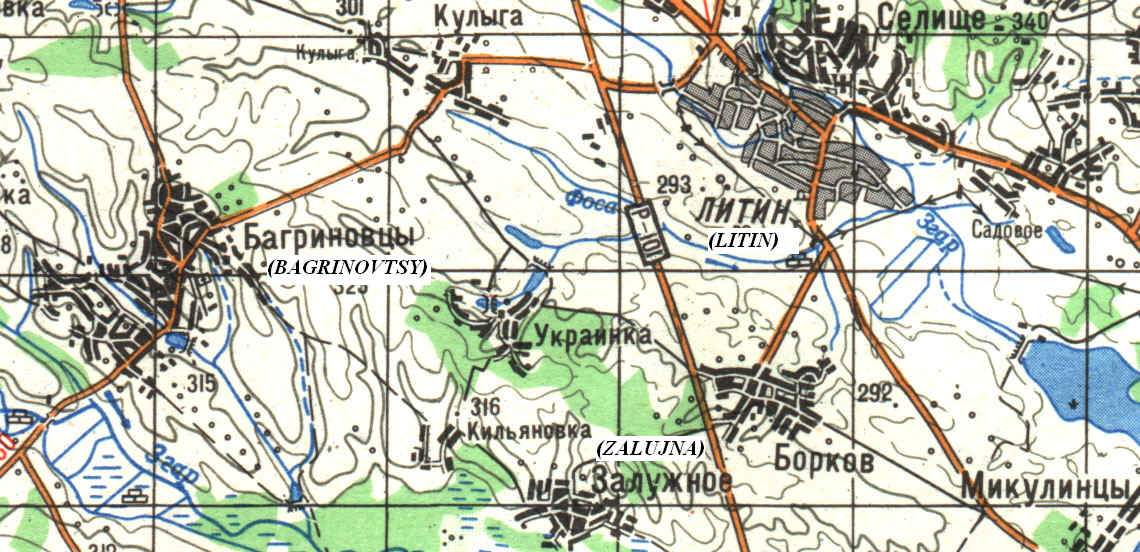
guess was that the land existed somewhere between Bagrinovtsy, the
birthplace of the Pervins and Litin, a town recorded as the last
residence of the family. An episode as told by Samuil’s family
follows: On
the sunset of every Sabbath, the owner of the factory, the oldest Pervin
son, Leib and the factory manager, Samuil, the second son were
accustomed to returning home from the factory on foot.
Their families, half way with a picnic of food and tea, met the
brothers. According to the map, the distance between Bagrinovtsy and
Litin is less than 16 K, that means the adults can walk the distance in
a couple of hours. In the
time before the revolution, one can imagine how the workday began as
early as four O’clock in the morning continued to seven O’clock in
the evening. If their
traveling time lasted less than one hour, they would have most likely
commuted daily – but instead they commuted weekly. I
requested Vlad to ask Litiners the whereabouts to any sugar beet
factories operated around the town of Bagrinovtsy. Initially, no one
could remember any such factories. I knew there were at least 50
factories listed at the state registration office in Vinnitsa. It was
puzzling to think about no factories while the horizon was full of sugar
beet fields on both sides of the state highway.
After
a time, a bunch of Litiners recollected a sugar beets factory operating
at the south section of Litin. Some
of them remembered that the
factory was constructed sometime around the 1920’s. The factory I was
looking for would have been operating for two generations before than
Leib in 1920. 1920 appeared to be too recent of a factory but we decided
to visit the factory none-the-less. I
was surprised and pleased that Sasha offered to take us to the factory
site. Sasha sat in the car next to Vlad while Heidi and I sat behind
him. He no longer acted like a stranger and behaved as though he
had been long acquainted with us. It
may take a while but once trust is developed, friendships are quickly
made. I felt by accident, we traveled back in time to an ancient world
where strangers would kindly help each other. On
the way to this unknown sugar beets factory, Vlad and Sasha were
enjoying a discussion on the upcoming presidential election in October.
My impression about the people around here reminded me of the
people in Texas, who maintained strong sense of pride and self respect
about themselves and who always were ready to challenge the central
administrative power. Listening to Sasha, I perceived him to be a
political conservative.
|
ZALUZHINOE
|
|
A Family Myth About Sugar beets Factory
|
|
| There is a tale told among the Pervin family for a number of generations.
One of those tales is about how a member of the Pervin family
obtained first-class Russian citizenship despite the fact that Jews were
considered second-class citizens. Most importantly, the family owned a large parcel of land,
thought to be quite unusual for Jews of this time. This was made
possible by the first generation of Leib Nicholiavitsi, who served with
the military for a life-long assignment.
It was Leib Nicholiavitsi who earned the rights to first-class
citizenship and accordingly was awarded all the rights of this
citizenship by the Tsar including the ownership of land.
However, none of his family had any documentation of the exact
location of the property. Israel Samuil, the younger brother to Leib
Yahuda remembered the name of the factory called “Loznansk Sackerine”
and yet no one could explain if this represented an individual or a
location. My guess was that the land existed somewhere between Bagrinovtsy, the
birthplace of the Pervins and Litin, a town recorded as the last
residence of the family. An episode as told by Samuil’s family
follows: On the sunset of
every Sabbath, the owner of the factory, the oldest Pervin son, Leib and
the factory manager, Samuil, the second son were accustomed to returning
home from the factory on foot. Their
families, half way with a picnic of food and tea, met the brothers.
According to the map, the distance between Bagrinovtsy and Litin is less
than 16 K, that means the adults can walk the distance in a couple of
hours. In the time before
the revolution, one can imagine how the workday began as early as four
O’clock in the morning continued to seven O’clock in the evening.
If their traveling time lasted less than one hour, they would
have most likely commuted daily – but instead they commuted
weekly. I requested Vlad to ask Litiners the whereabouts to any sugar beet factories
operated around the town of Bagrinovtsy. Initially, no one could
remember any such factories. I knew there were at least 50 factories
listed at the state registration office in Vinnitsa. It was puzzling to
think about no factories while the horizon was full of sugar beet fields
on both sides of the state highway.
After a time, a bunch of Litiners recollected a sugar beets factory
operating at the south section of Litin. Some
of them remembered that the factory
was constructed sometime around the 1920’s. The factory I was looking
for would have been operating for two generations before than Leib in
1920. 1920 appeared to be too recent of a factory but we decided to
visit the factory none-the-less. I was surprised and pleased that Sasha offered to take us to the factory
site. Sasha sat in the car next to Vlad while Heidi and I sat behind
him. He no longer acted
like a stranger and behaved as though he had been long acquainted with
us. It may take a while but
once trust is developed, friendships are quickly made. I felt by
accident, we traveled back in time to an ancient world where strangers
would kindly help each other. On the way to this unknown sugar beets factory, Vlad and Sasha were enjoying
a discussion on the upcoming presidential election in October.
My impression about the people around here reminded me of the
people in Texas, who maintained strong sense of pride and self respect
about themselves and who always were ready to challenge the central
administrative power. Listening to Sasha, I perceived him to be a
political conservative. While I was listing to the Ukrainians’ political discussion, I could not
help wondering if we had traveled too far south. We should have traveled for thirty minutes and yet we still
had not arrived at the destination. I interrupted the conversation
between Vlad and Sasha and asked if we should have already arrived at
our destination. I heard
Sasha saying to Vlad that it was farther south.
At this point I interrupted again and asked Sasha if he had heard
of “Loznansk”. While I was listening to Vlad translating my question
into Russian, I noticed Sasha’s immediate reaction when he heard the
word. “Loznansk?” repeated Sasha. “You
mean Zaluzhnoe” I knew the
name of Zaluzhnoe
from the map I had studied about the neighboring villages of Litin. The
village sat right between Bagrinovitsy and Litin.
I was lucky to have practically memorized all the small towns
around this area. “Is Loznansk called Zaluzhnoe at this time?” asked Vlad to
Sasha. Sasha replied “Yes” to
Vlad. Now, Sasha appeared to have understood everything and told us that we had
passed Zaluzhnoe long time ago and should go back to the village at
once. The part of my misunderstanding was the name of “Zaluzhnoe’
which was not a personal name as I had assumed but instead was a
geographic location. This is what we found out later. Many of the local villages changed their
name after the revolution. Zaluzhnoe
was one of them. There was a bus stop decorated with a wall of mosaic
arts with the name “Zaluzhnoe” written in the mosaic.
It appeared to be an entry road from the state highway to the
village; it looked significantly old but meticulously well paved with
square bricks, which gave the appearance of marbles. The road veering
towards the village looked as wide as the state road and reminded me of
the well-designed ancient Roman roads built for carriages and wagons.
The avenue was lined with cherry trees. When I saw this picture
in front of me, I knew we had arrived at the right place. I had an impression, which I cannot fully explain but I know
I was here before - I had once pictured this scene in my mind before.
We had arrived at the right village.
The car went into the paved road for one kilometer. I imagined
that I was on the same road on which the Pervin family had walked
together every Sabbath eve with the sun setting behind them into the
horizon. I saw, in my mind,
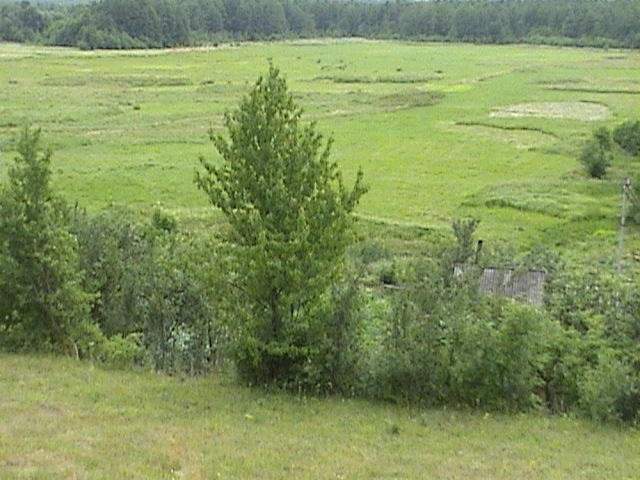
this scene many times. The village with 200 inhabitants set upon a hill in the middle of meadow. I
imagined a childhood image of the legendary Scotland village called
“Brigadoon”; a utopian world hidden behind the fog. In the fresh air, I heard screams of ducks and chickens.
Heidi murmured that she sensed the fragrance of wild flowers and
the smell of farmland where she was raised, Toledo, Ohio. Sasha walked out of car and summoned about ten villagers.
We had caught the attention of the entire village already. Sasha
asked if anyone knew anything about a sugar beet factory operating in
this village as he stood with his arm perched on a gate belonging to one
of the villagers. They responded by saying they never heard of the sugar
beets factory. With this reply Heidi and I looked at each other with a feeling of the
ground at our feet suddenly cracking open in disappointment. However,
one of the villagers among the crowd stated loudly: “Wait!” she yelled. “I remember there was one distillery which
operated here once upon a time, though it was destroyed!” “Distillery”? I pondered. I
had no idea what the word meant. “That is right, a distillery.
It was burned and destroyed to the ground when a troop of Bolsheviks
came by during the October Revolution!”
I saw Vlad carefully listening to the woman and he directed questions to her
so quickly that I could not understand the contents of the questions.
The October Revolution took place in 1917.
I do not know why a distillery would offend the revolutionaries;
perhaps the factory was producing something the revolutionaries do not
approved of. As far as I
understood, the Pervins were sugar merchants.
Sugar could not cause any problems for the revolutionaries, I
kept asking my self. What
did a distillery have to do with sugar?. Vlad, on the other hand, appeared to have realized something. “Mr. Yamaguchi!” yelled Vlad. He always addressed me as Mr. Yamaguchi whenever he was excited. He started
to explain the process of making alcohol using a distillery.
He told me that the distillery is the factory that produces
alcohol. Since I have been no experience with liquor products - since a
pickled cucumber could intoxicate me - I had no idea about the liquor
making process using sugar beets. I started to understand the whole
picture; that is, this was a factory that could produce gin, whisky or
vodka. I looked at Heidi and saw her big smile. Breaking her silence, she started
to giggle and finally with a loud laugh. For a while she could not stop
laughing as if she had caught a funny line of a stand-up comedian.
I was appalled. I had no idea what was happening to her mind and lost how to
inquire as to why she was laughing.
She told me that we came to find the right place.
She kept repeating the statement without telling me why this is
the right place. “Norimi, don’t you see? My ancestors were bootleggers!” “Bootlegger?” as I still did not understand what Heidi was talking
about. Confused as I was, I once again drew a map in my mind of a
triangle with the towns of Bagrinovitsy, Zaluzhnoe and Litin at each of
the three points. They
formed an equilateral triangle, where each town was 10 km from the
other. I t would take
someone two hours to walk to any of the towns. That fits the distance in
the stories told among the Pervin family. A memorable time in the US was
the period of Prohibition. It
lasted from 1919 to 1933, 14 years duration. During this time, the
distributing and drinking of alcohol products were prohibited. Every
child knows the story in connection to an outlaw named Al Capone. I, myself, recalled an episode told among the members of Samuil Porvin’s
family that related to the story of Shieva, Samuil’s wife, who was
fatally victimized by a mob during the pogroms in the 1920s. According
to the story, Betty, the oldest of the Samuil’s five children operated
a business selling liquors in order to take care of the household. This
was the only means by which she could earn enough money to exit Ukraine
and travel to the United States where their father was waiting.
According to the story, Betty was merely 14 years of age.
My question had always been, “how would a 14 year old know how
to process liquors and run a business doing so”? Now I understand;
this was her family’s profession. There was one more rumor I needed to take into consideration.
A mysterious Pervin family member lived in Florida.
They say David R. Porvin lived in Miami, Florida, was a casino
hotel owner and was allegedly a member of Al Capone’s group. I
remembered I was confused about how a Jewish immigrant had become
involved with an underground organization. It is now clear to me that if someone was a distiller, he
could easily gain entry into an illegal but closed organization.
Before this trip, I did in fact confirm with Heidi’s father of
David Porvin’s existence. He remembered David as a rich gang member,
somewhat mysterious, who owned a casino and was always sending expensive
gifts to the Pervin family. Now that I have gathered these episodes, I can make some sense of the
family’s profession as a distiller. Based on the 1930 US Census,
Samuil Porvin is listed as a sales person. There is also the general
belief that that his second wife was trading in alcohol. I realized I need to be sensitive about this finding.
Should I disclose the information we have found here in Zaluzhnoe
in as much as most of the current Pervin family believes the family
profession was that of processors of sugar beets? Though Heidi referred to her ancestors as bootleggers, not all distilleries
are illegal. The distillery
business is a legal one. I sensed something about Heidi who has been
skeptical about her family’s origins and she is somewhat judgmental of
them and I do not understand the reason.
She always perceived a shadowy side to her family.
She explained to me once that she believed there were skeletons
hidden in the family closet. Her grandfather, Max, for example, came to
US supposedly when he was 14 years of age.
Some have said that he was involved in a scandal and may have
harmed someone in the process; therefore needing to hide his identity.
We cannot locate any records indicating when and how he entered the
States. Only a marriage
certificate shows that his “birthplace” as Detroit. Now we know that
Max was not born in Detroit. So, if the family operated a legal distillery, then why would they tell
their children they operated a “Sugar Beets Factory”? There is no
shame in the occupation as a distiller. I saw a contradiction as I heard the story of how this factory burned down
at the hands of the Bolsheviks during the October revolution in 1917.
Mr. And Mrs. Yahuda Leib Pervin immigrated to Toledo, Ohio in
1923; 5 years after the revolution. I interpreted the information as
such: Heidi’s great-grand parents left their birth place after they
sold the property and with the money they earned from the sale, they
managed to buy passage to the US for all members of the family. If the
factory had been destroyed, how could they sell the factory? I needed to
learn more detail about the factory.
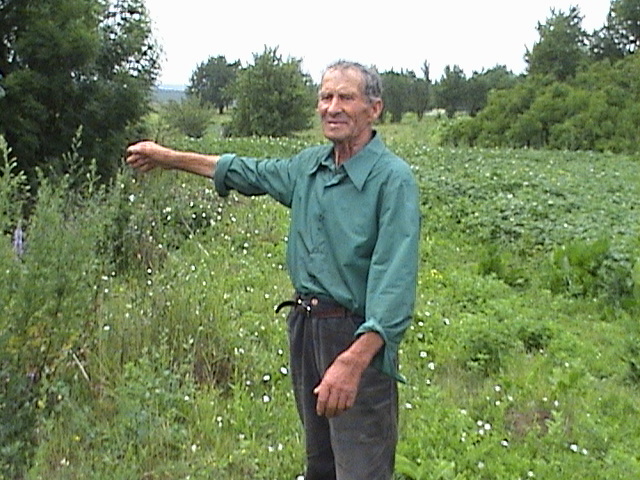
I asked Sasha to find the eldest in the village. The
following is from the story as told by Illya, the eldest of the
villagers who gathered to explain about the distillery. A
Story Told by Illya “People
call me Illya and I am the oldest in this village.
Da. My father told me this story, da! It happened before I was
born, da. There once built and operated a big Alcohol factory right
behind that house at the entrance of this village, da.
Who owned that factory? Da, I know who.
It was the Pan, the Polish noble landlord, da! Pan, Paliakoff! Da,
that was his name. Niet, he never was the Jewish man! It was when the
October revolution took place, da, when the army of Bolsheviks over
whelmed the village and attacked the factory, put fire on the factory,
destroyed that factory down to the ground, da. My father told me that to
make money by making alcohol was an act of the bourgeoisie, a criminal
act, da. The basin down the road once was a pond, da. A large pond they
said, da.
A little sized lake, a large pond, da. It was full of flowing
water.
But when the vat at the factory exploded, da, all of the spirits
spilled into the pond, da, and what happened was that all the villagers
ran to grab their buckets and jumped into the pond to gather the
spirits, da, but the Bolsheviks lit the spirits on the pond, da, and the
whole pond burned like an inferno, da. Many, many people were in the
pond when the flames began, da. It was my father who said the view was
of hell, people were burning in the fire, da. This is the spot where the
factory once was stood, da. If you dig deep into this land they say you
will find many, many treasures.
Da, there is a legend that a golden candlestick is hidden
somewhere underground.
Niet, I have never attempted to dig out the treasures, da.” The
village elder, Illya was a genuine and adorable man who tried to explain
everything he knew.
He used “Da (yes,) and Niet (no,)” repeatedly as he talked.
The legend about the golden candlestick perhaps is a golden Menorah. It
was useful to learn about Pan Paliakoff, the Polish landlord, who owned
the factory.
Illya explained that Pan Paliakoff disappeared from the village
after the factory fire. He said the Pan ran away to his homeland,
Poland. This means that Leib and Israel Pervin were no longer the owners
of the factory at the time of the October revolution.
I pondered the ownership question and the fact that Israel, the
younger brother to Leib was recorded to have entered the US as early as
1914. It
is said that Israel heard the news of the beginning of World War I when
he was at sea near the International Date Line – somewhere in the
Pacific.
At this point, the owner of the Zaluzhnoe factory was not the
Pervins but instead Pan Paliakoff. Israel managed the factory for Leib,
and as he was traveling to the US then it is quite likely that both Leib
and Israel were in the process of immigrating to the US. I
wondered how, for nine years, Leib made a living to support his children
without the income from the factory. I was puzzled by something else. We
have a document that shows that the five children of Israel arrived in
Detroit in 1921. According
to Rochell Tobisman, the youngest daughter to Beverly Porvin, her
grandmother, Shieva (Israel’s wife) was killed during the pogroms in
Litin on March 19, 1919. Rochell explained to me why she believed that
was the day of Shieva’s death. Rochell remembered her mother’s
birthday as March 19, but did not know the year.
Her mother, Beverly, knew March 19 was not her birthday. The date
instead was the date her mother was killed and in order to always
remember the date, her brothers and sisters established the day as
Beverly’s birthday. In this way, the siblings would always remember to
cerebrate the anniversary of the death of their mother. About 2 years
ago, Rochell discovered that the date of March 19, 1919 was the date of
a severe pogrom in Litin. There
is a possibility that all the members of the Pervin/Porvin family still
resided in Bagrinovitsy while commuting to the factory at Zaluzhnoe
– not yet in Litin at this time.
My next action is to visit Bagrinovitsy, their birthplace. We
bid farewell to the Zaluzhinoe villagers, promising we would come back
within a day or so. We returned to the car.
We were so pleased that Sasha offered to escort us to
Bagrinovitsy.
The time was 4 O’clock in the afternoon. We
were told there was a short cut by walking to Bagrinovitsy.
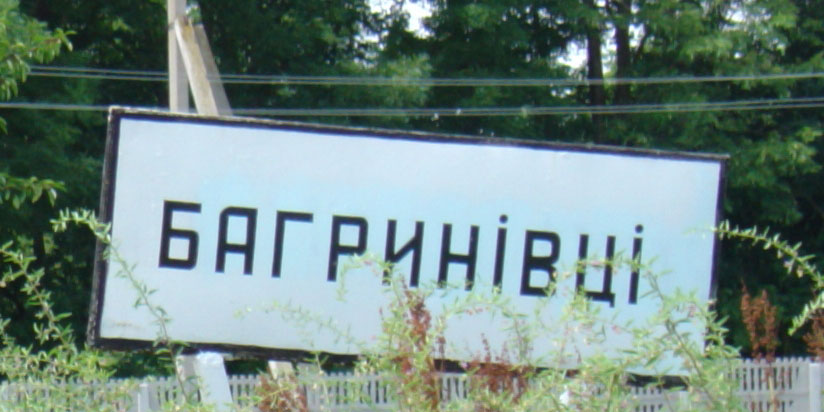
However, it did not even take 20 minutes by car. We stopped at
the eastern entrance to observe the village sign of “Bagrinovitsy.”
I could hear my heart thumping loud but tried to control myself so as to
not get too excited; first I wanted to take a swift drive through the
village to gain a sense of direction.
We were exhausted from the constant excitement after excitement
since this morning. It would cause us of mental indigestion if we were
to push too hard. I, therefore, offered that we simply drive through the
village without interviewing anyone or taking any pictures. Bagrinovitsy was a quiet village setting in the green forest like an oasis in the desert. Sasha informed us that there were about two thousand currently living in Bagrinovitsy. I was very surprised that there was almost the same number of Jews living in 1920, which means little had changed as far as the total population. It was certain however - there were no Jews living here now. We then encountered with a large herd of cattle. |
|
| BAGRINOVITSY |
|
THE BIRTH PLACE FOR PERVINS
|
|
We
were told there was a short cut by walking to Bagrinovitsy.
However, it did not even take 20 minutes by car. We stopped at
the eastern entrance to observe the village sign of “Bagrinovitsy.”
I could hear my heart thumping loud but tried to control myself so as to
not get too excited; first I wanted to take a swift drive through the
village to gain a sense of direction.
We were exhausted from the constant excitement after excitement
since this morning. It would cause us of mental indigestion if we were
to push too hard. I, therefore, offered that we simply drive through the
village without interviewing anyone or taking any pictures. Bagrinovitsy was a quiet village setting in the green forest like an oasis in the desert. Sasha informed us that there were about two thousand currently living in Bagrinovitsy. I was very surprised that there was almost the same number of Jews living in 1920, which means little had changed as far as the total population. It was certain however - there were no Jews living here now. We then encountered with a large herd of cattle. Sasha
had been with us for nearly the entire day. Now we needed to take
him back to Litin. It was time to end our day. We would visit Bagrinovitsy again
tomorrow. We left the village reluctantly. |
|